
―コンパクトだからできること―
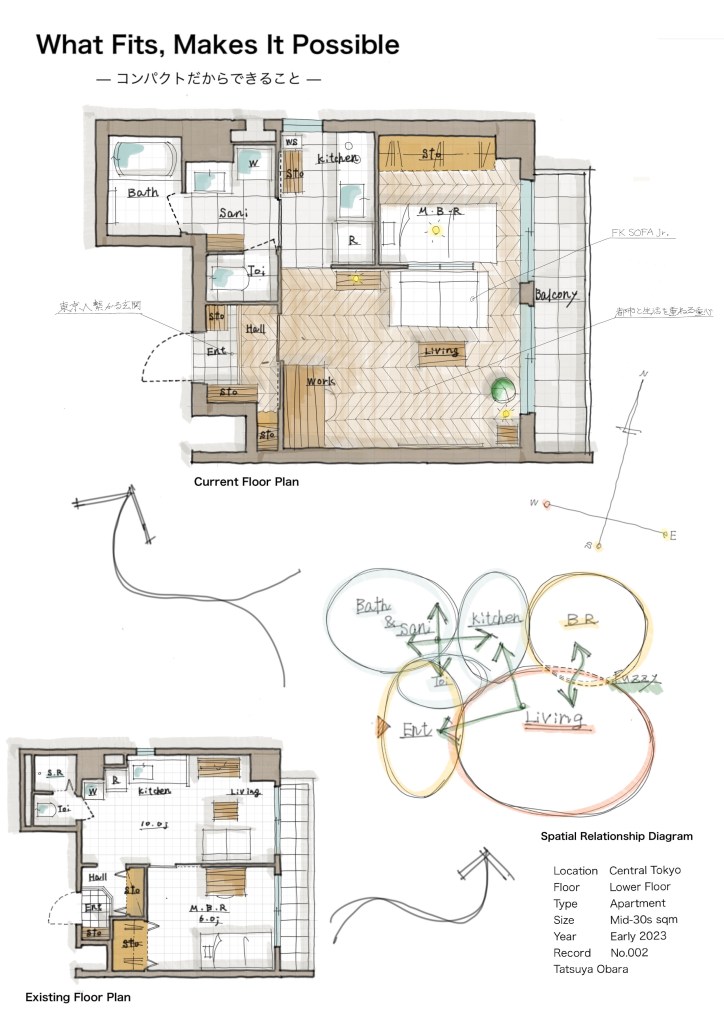
この住まいは、
寝室や水まわりを最小限に抑え、
暮らしの重心をリビングに置くことから考えた。
住む人はミニマリストで、
家に求める役割も明確だった。
広さを増やすことより、
一日の大半を過ごす場所が
気持ちよく使えることを優先している。
都内の中心部に住むことは、
この暮らしにとって重要な条件だった。
そのために、面積はあえてコンパクトに抑え、
予算を空間の質に振り分けている。
限られた広さの中で、
どこに余白をつくり、
どこを削るか。
その判断を、間取りで整理した。
リビングには、
どうしても置きたいソファがあった。
そのサイズと居場所を起点に、
生活の動線や視線の抜けを整えている。
この家は、
多くを足すための間取りではない。
必要なものだけを残し、
暮らしの中心をはっきりさせた結果である。
住まいの判断を、
ひとつの記録として残している。
This home was designed with the living room
as the center of daily life,
while the bedroom and wet areas were kept to a minimum.
The resident is a minimalist,
with a clear sense of what a home should provide.
Rather than increasing size,
priority was given to making the space
where most time is spent feel comfortable and calm.
Living in the heart of Tokyo
was an essential condition for this lifestyle.
To achieve that,
the overall size was intentionally kept compact,
allowing the budget to be directed toward the quality of space.
Within a limited footprint,
choices were made about
what to leave open
and what to remove.
Those choices were resolved through the floor plan.
There was one sofa that had to be placed.
Its size and position became the starting point
for organizing circulation
and the flow of sightlines.
This home is not about adding more.
It is the result of keeping only what was necessary
and making the center of life clear.
The decisions behind this home
are kept as a record.
Tokyo / Central Area
Lower Floor / Apartment
Mid-30s sqm / Early 2023
Record No.002
Tatsuya Obara
この図は、
住まいの判断を記録したものとして
贈られた。
新しい暮らしの節目に、
あとから振り返るために、来客との会話が自然と生まれるための図である。
この記録は、
住まい・仕事場・店舗など、
「用途を決めきれない空間」を
どう成立させるかを整理したものです。
図面と空間の読み取りを、判断の構造として整理した記録。

.
 BACKYARD OFFICE