
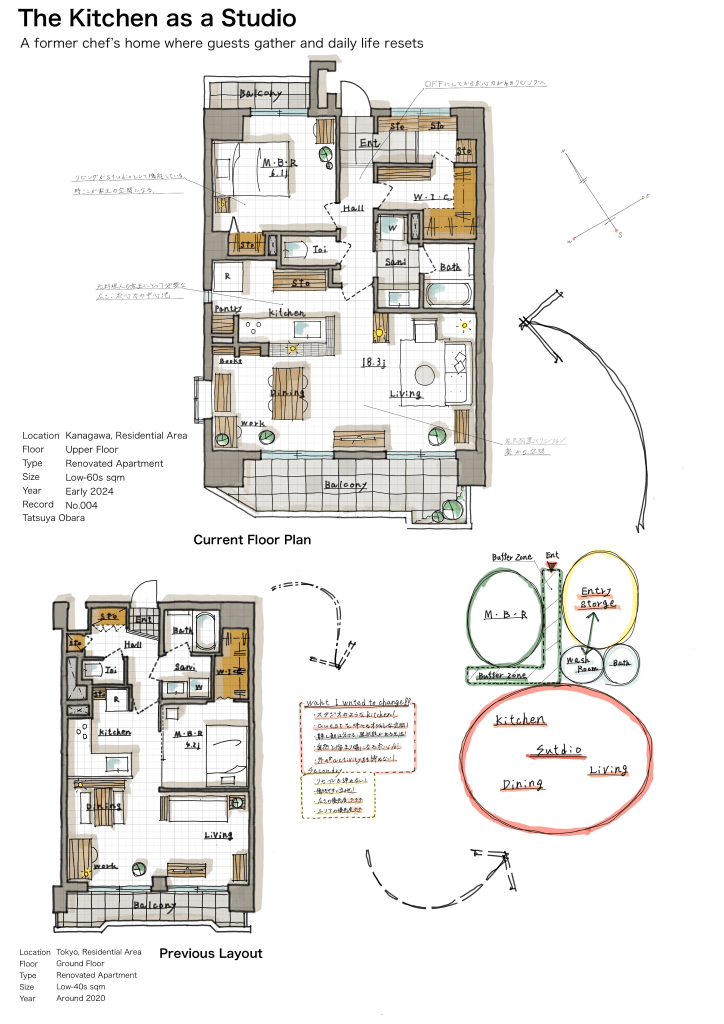
この住まいは、
キッチンを起点に考えられている。
住む人は元料理人で、
料理や食事の時間を
暮らしの中心に置いてきた。
人が集い、自然と滞在が長くなる空間を
住まいに求めている。
以前の住まいは、
立地や将来性を重視し、
安定した条件のもとで選ばれていた。
合理的で、無理のない判断だった。
一方で、
日常の重心は少しずつ別の場所へ移っていった。
つくること、囲むこと、
誰かと時間を共有することが、
暮らしの中でより大きな意味を持つようになった。
現在の住まいでは、
その変化に合わせて間取りを組み替えている。
キッチンは、
単なる設備ではなく、
作業・会話・集まりが重なる「場」として扱われている。
ダイニングやリビングと連続し、
暮らしの動きが一つの空間に集約されている。
広さを求める一方で、
場所の選び方や将来を見据えた視点は手放していない。
広げることは、妥協することではなかった。
この家は、
一時的な理想を形にしたものではない。
これまでの判断と、これからの意図を
ひとつの住まいに重ねた結果である。
住まいの使われ方と、
そこに至る判断を、
ひとつの記録として残している。
This home began with the kitchen.
The resident is a former chef,
for whom cooking and shared meals
have long been central to daily life.
The home was conceived as a place
where people naturally gather
and spend time together.
The previous residence was chosen
with location and long-term stability in mind.
It was a rational, well-balanced decision—
carefully considered and practical.
Over time, however,
the center of everyday life began to shift.
Cooking, gathering around food,
and creating a space where guests could linger
gradually became more important.
In the current home,
the layout was reorganized
to reflect that shift.
The kitchen is no longer treated as a utility,
but as a central place—
where work, conversation, and activity overlap.
Dining and living areas flow seamlessly,
bringing daily life into a single continuous space.
While seeking more room,
attention to location and the future
was never set aside.
Expanding the space did not mean compromise.
This home is not a temporary ideal.
It reflects a series of decisions—
past judgments and future intentions
held together in one place.
How the home is lived in,
and the choices that shaped it,
are kept as a record.
Kanagawa / Residential Area
Upper Floor / Apartment
Low-60s sqm
Early 2024
Record No.004
Tatsuya Obara
この記録は、実在する住まいをもとに、
間取りや空間構成をどのように判断したかを整理したものです。
設計事例やリノベーション事例としてではなく、
住まいの判断そのものを記録として残しています。
図面と空間の読み取りを、判断の構造として整理した記録。
.
 BACKYARD OFFICE